
Longing for space.
It would be a bluff if I tried to take in the company, making them believe I know this game, just to use the opportunity I have and play my cards. Well, it isn’t quite that way. And you should not expect me to have any experience in this trade. Although one evening, the author of those works satisfied my curiosity. He had “presented” me the whole technological process, which probably harks back to the Master from Amsterdam – from working with small chiselsand potentially any material, to etching the matrix, to producing numerous prints. lt was a lesson in humbleness, on the subject called Graphic Art, which I had to learn well. Earlier on, as befits a layperson, seeing the effects of such work on display in galleries I did not have the faintest idea of it. Tomek gave me a yet another lecture on creative psychology since the high school years – one about concentration, perseverance, patience, about self-discipline and sacrifices. He showed me the way of a long-distance runner, which is not free of risk.
Those interested in this very aspect of his graphic art work should refer to the text by Maciej Gutowski, for which the author of the discussed works has a deep respect. Gutowski was the first to write a comprehensive review about the quartet of graphic artists who formed the PAKT group. And so, it is not by chance that those artists are so willing to reprint this text in their catalogues. But there were others, equally recognized, who wrote as well. With people like Magdalena Hniedziewicz, Rafal Strent or Stanislaw Wieczorek writing about one’s artwork, what else should one ask for? Thus, Tomek does not need ennoblement – not to mention the fact that I could not be of any help in this matter.
What is there left to do? I should say a few words, since, in case of this art, a lot depends on the viewer and his personal “discovery”.
What is it that I see in his works then? I perceive – with varying strength – his solidity, perfection, even flashes of virtuosity. I see affection for the heavy but transient matter which is, at the same time, ascending and falling down (fallen?), I also see solidity of foundation (one can believe in it), and archetypal world of symbols (winged lcarian flight and Borges’ labyrints – Daedalus). But above all, I see the precision of the tools meant to extol the creative effort of the individual. The ethos of mastering the workshop. Time will tell whether, facing the deluge of digital images, works of Tomasz Kukawski and others are to become the last elegies on the death of the chisel, the linoleum, and the press. But his attachment to geometrical shapes – circles, rectangles, triangles, ellipses and prisms – tells of a three-dimensional, spatial and architectural imagination (therefore his college years did not go to waste).
Without a doubt he is occupied with metaphysical problems – time and space. Lncluding the construction of an own mental space which remains spiritual, unreal. There is too little of an anecdote, narration and not enough of a person in his works – this causes trouble with perceiving anything finished. For their main subject is precisely i n f i n i t y. A journey into the unknown…? All in all, I cannot provide a clear answer if – according to a graphic artist – this road leads to God or to nowhere.
At the very beginning of his travel – about 20 years ago – the author (which he admits) sought inspiration in the works of Gielniak and Max Ernst that stimulated his interest. Surely,a professional observer can spot that. Recently however, he is even more interesting while stating opinions: he claims that, since some time, he’s been fascinated by Jerzy Panek’s simplicity, giving up any kind of visual idle talk and focusing on asceticism of the print.
lt seems that being on the arc of the road, Tomek is currently at the peak but it is hard to imagine whenand where he will… reach the finish point.
Just keep a steady pace! Or forget about it and do your job, more, more. No looking around.
Harder, higher, more!
I am curious about the new.
Bialystok, 5 XII/ 2003
Jaroslaw Sieradzki
(…) In the very beginning he made linocuts, etchings and aquatints. Since 1997 he has devoted a lot of time to experiments in which he used all the techniques along with colography. As he says, he treats working on each new piece as an adventure. He constantly takes upon himself new tasks, and faces new problems – the mare difficult they seem, the more interesting they are. When it comes to using several matrixes a wide color palette at the same time and, serious difficulties arise. These require a lot of imagination and the ability to predict, as one has to think of both the first and the finał colors while bearing in mind that this is actually a mirror reflection, a negative picture etc. As he admitted recently, he is able to predict the final effect. Why? Years of experiments and years of work, technological knowledge, experience but above all – iron discipline. He successfully uses his technique and creates formally sophisticated visual effects while paying a lot of attention to every single graphic detail. (…) Most of the titles of Kukawski’s works are in English as he doesn’t want the viewer to be strongly influenced by them. What do his works depict? lt is difficult to describe actually because there is no anecdote in them. These works are to be looked at, contemplated and chewed over. Despite their rich texture and graphic matter they are synthetic, based on a elear rule of composition, simple divisions and usage of large planes. The signs and symbols used, such as the spiral or the wings, tell about eternity and the passing of time. (…)
Grzegorz Mazurek (2002)
(…) Tomasz Kukawski knows best what intaglio is. Unfortunately, I do not… As a matter of fact, intaglio sounds esoterically enough to suit perfectly to the mystical subject matter of his poetic works. He is a master of form, color and light. His works are produced with Benedictine care of every graphic detail, which does not interfere with creating an atmosphere of lightness with tasteful colors. The artist contrasts botanical forms with geometry. By doing this, he is creating visual tensions between the extremes, which for him have a reflective dimension. (…)
Antoni Szoska (2000)
(…) For Tomasz Kukawski this would be the world of archetypal, cultural signs, a world of images and meanings hidden behind them. The signs are barely suggested, sometimes distant, sometimes close, alluded and open to different interpretations and, at the same time, they themselves are the reconstructions of those archetypal ideas. lt is not the anecdote but the sign which is of greatest importance here. A sign which is so general that it refers to the most basic and rudimentary elements of human condition, his existence in the world and his psyche, which absorbs it. (…)
Magdalena Hniedziewicz (1999)
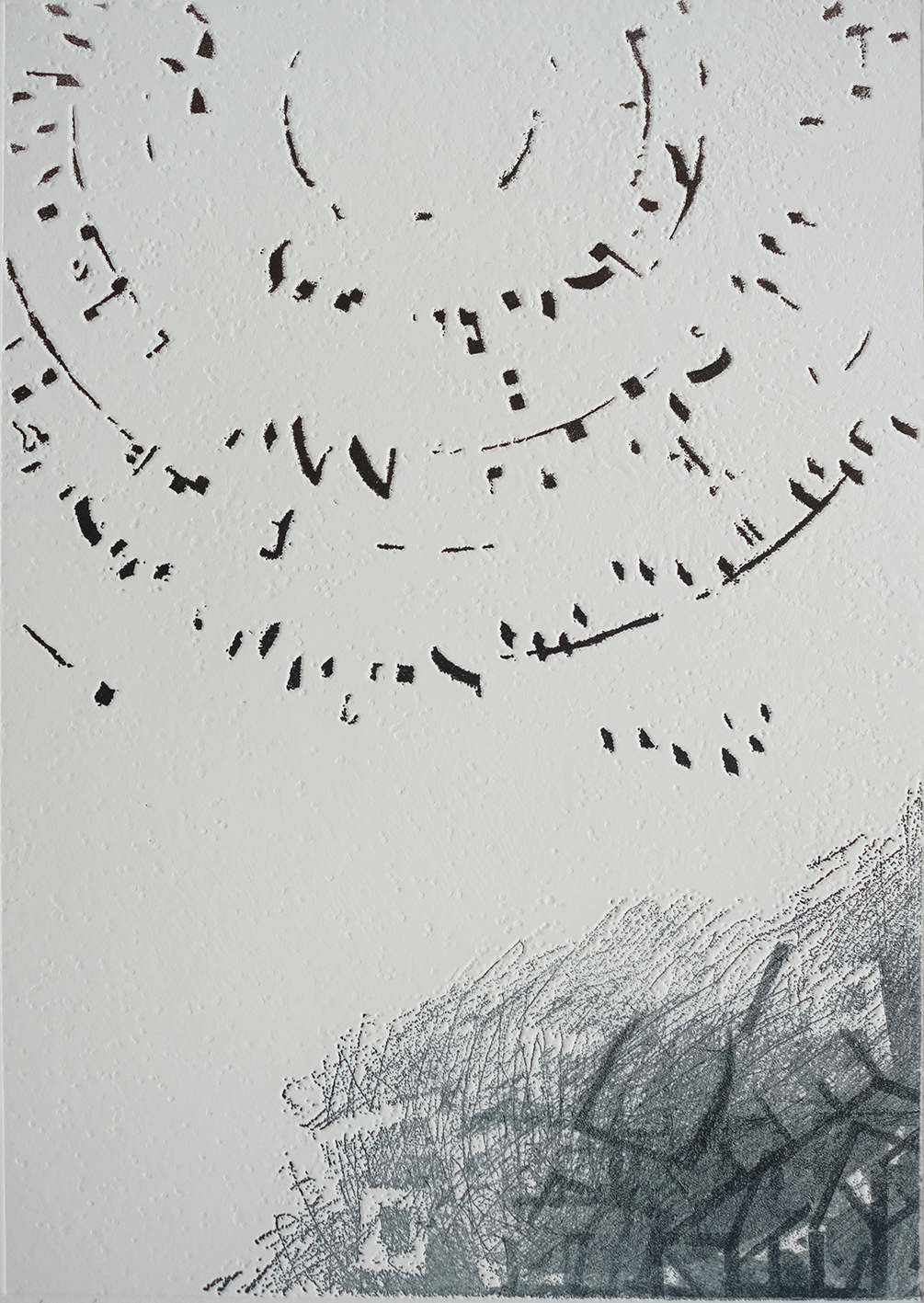
(…) In case of Tomasz Kukawski, focusing on the workshop does not mean limiting the work to merely one technique. He successfully practices zincography and reaches various effects of color, texture and condensation, from dry and shallow to deep and saturated ones. But, having a considerable experience in linocut prints, he feels equally at ease, individually developing new ways of expression, while using the technique which was once made famous by the works of Jozef Gielniak. Recently however, he seem keen to create complex, multilayered works, based on linoleum and metal, which are difficult and require precision, as well as great patience in the process of printing. He also willingly introduces color. Here, the world of meanings is created out of symbols and metaphors which – despite archetypally circulating in our culture – are shaped individually. They aren’t oppressive, and sometimes even hard to fellow. Eventually – and I am not sure to what extent this effect was reached intentionally – a somewhat magical picture emerges, in which the gist and the meanings are rather hinted at, than unambiguously explained.
Those riddles, entanglements, unexpected elucidations and yet another mysterious evasions, resemble the state of being lost in the labyrinth of thoughts – like the attempts to read the unreadable nature of existence. The mentioned signs and symbols – even if they originate from the realm of nature – will always belong to those rudimentary ones, which are peculiar to the Mediterranean tradition. (…)
Maciej Gutowski (1998)